Invoicing International Clients: Currency, Tax and Payment Details to Get Right
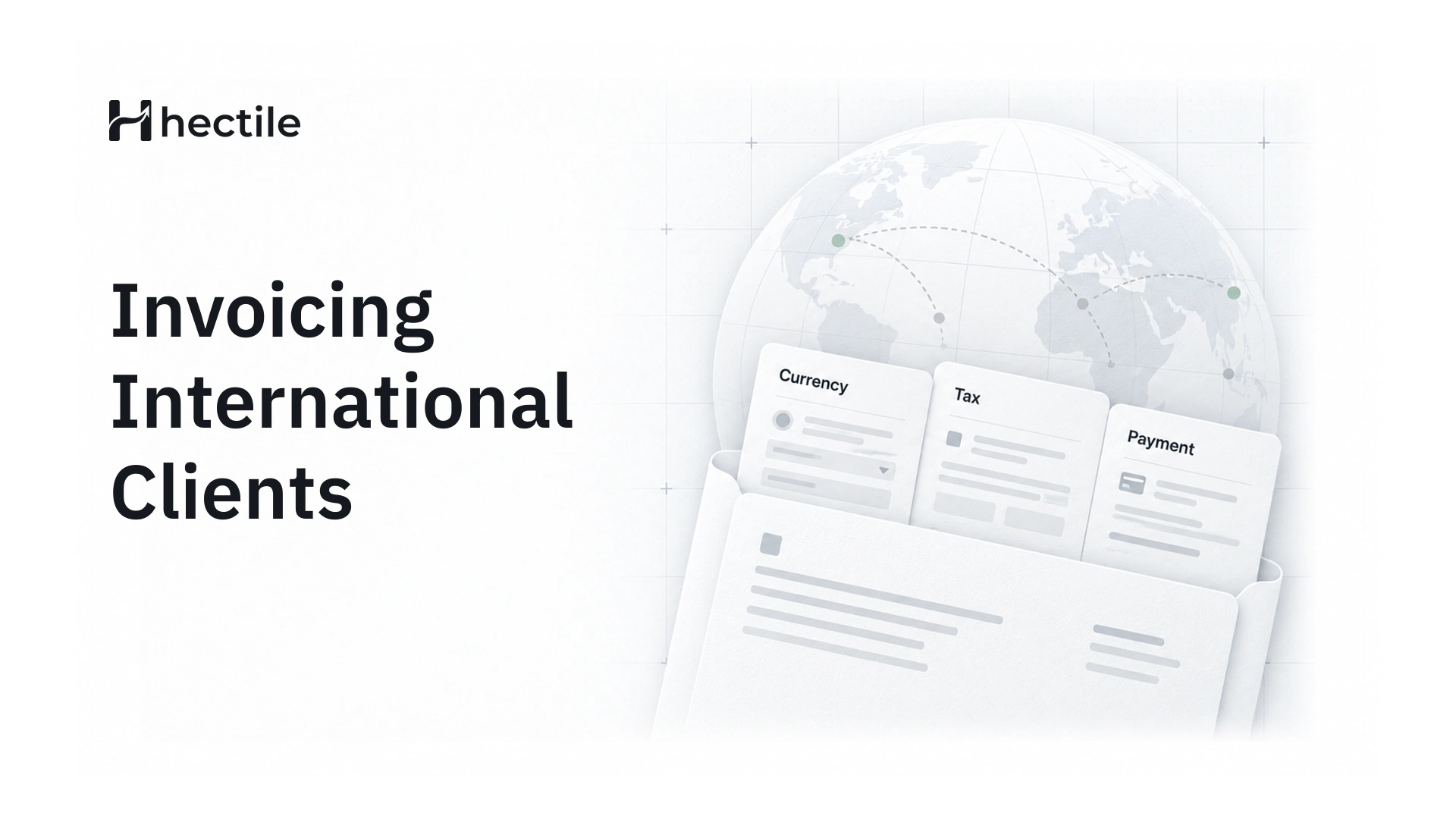
Billing a client in another country raises questions a local invoice never does. Which currency, which tax, which bank details, and who pays the fees.
Written by: Hectile TeamPublished 7 min read
The first time Arjun, a developer in Pune, invoiced a client in the United States, he did everything he'd normally do. He billed in rupees, added GST, attached his usual bank details and waited. A week later the client's finance team wrote back with three questions: what was the amount in dollars, why was there Indian tax on it, and what was the SWIFT code? The payment arrived a month late and about 2% lighter than expected, thanks to bank charges nobody had discussed.
None of those problems was difficult to solve. They just weren't problems he'd had before. Invoicing international clients comes with a short list of decisions that local invoices never ask you to make. Make them once, write them into your process, and cross-border work becomes as routine as anything else.
Decide the currency first
Before you send a single invoice, agree the currency with your client. There are two main options.
Invoice in your client's currency
Billing a US client in US dollars or a UAE client in dirhams is often the friendlier choice. They know exactly what they owe, and they don't need to convert anything. The trade-off is that you take on the exchange rate risk: if the rate moves between invoice and payment, the amount that lands in your account changes.
Invoice in your own currency
Billing in your home currency protects you from rate movements, but pushes the conversion onto the client. Some clients won't mind; others, especially larger companies, prefer or require invoices in their own currency.
Whichever you choose, write it in your estimate or contract, and use currency codes rather than symbols on the invoice. "USD 3,000.00" is unambiguous. "$3,000" could mean US, Canadian, Australian or Singapore dollars.
Exchange rates: who carries the risk?
If you invoice in a foreign currency, decide how you'll handle the conversion for your own records. A few practical points:
- Record the rate you used if you need to report the invoice in your home currency, and keep a note of where it came from.
- Expect the received amount to differ slightly from the invoice converted at today's rate.
- For long projects, consider agreeing that large exchange rate swings can be revisited, so neither side carries all the risk.
Some tax systems require the tax amount to be shown in local currency even when you invoice in another one. The UAE, for example, requires the VAT amount in dirhams. Our guide to UAE VAT invoice requirements covers that in detail.
Tax on cross-border invoices
Tax is where international invoices most often go wrong, and the rules depend on where you're registered, what you supply and where your client is. A few general patterns are worth knowing, but check the specifics with your adviser.
- Exports of services are often zero-rated. Many tax systems don't charge local sales tax on services supplied to clients abroad, provided certain conditions are met.
- In India, a GST-registered exporter of services can usually supply without paying IGST under a Letter of Undertaking (LUT), and the invoice should state that the supply is meant for export under LUT without payment of integrated tax. Conditions apply, including that payment is received in convertible foreign exchange.
- In the UAE, exports of services can be zero-rated where the conditions are met, but the invoice still shows the VAT rate as 0%.
- Business clients in many other countries, including the EU, often account for VAT themselves under the reverse charge. Your invoice may need to say so and show the client's VAT number.
The common thread: don't simply add your local tax to every invoice, and don't simply leave it off either. Know which treatment applies and say so on the invoice. For India, our guide to the GST invoice format lists the other fields an invoice needs.
Withholding tax on cross-border payments
Some countries require a business to withhold tax from payments it makes for services supplied from abroad, and pay that tax to its own government. If that applies, the amount you receive will be lower than the invoice. In many cases a tax treaty between the two countries reduces or removes the withholding, usually if you provide a tax residency certificate from your own tax authority. Ask your client early whether they withhold tax on foreign payments, so the difference doesn't arrive as a surprise.
Details every international invoice needs
On top of the usual invoice fields, cross-border invoices should include:
- both parties' full legal names and addresses, including the country
- tax registration numbers for you and, where relevant, your client
- the currency code on every amount, and the total
- dates written unambiguously, such as 7 October 2026, because 07/10/2026 means different dates in different countries
- your bank details for international transfers: account name, account number or IBAN, SWIFT or BIC code and the bank's name and address
- the reference you want the client to use, usually the invoice number
- any tax statement that applies, such as export under LUT or reverse charge
Getting paid across borders
How you're paid affects how much arrives. A few things to agree in advance:
- The payment method. A SWIFT bank transfer, a local transfer through a multi-currency account, or a payment platform. Each has different fees and speeds.
- Who pays bank charges. International transfers can be sent with charges paid by the sender (OUR), shared (SHA), or paid by the recipient (BEN). If you need the full amount to arrive, say so in your terms.
- What your bank needs from you. In India, for example, banks may ask for a purpose code for incoming foreign payments, and the paperwork for export receipts. Check with your bank before the first payment arrives.
When the money lands, record the amount actually received, the date, the method and the bank's reference. If it's short because of fees, note it, and decide whether to absorb the difference or ask the client to cover it next time.
A worked example
Here's how one export invoice might look from a services business in India billing a US client:
| Item | Detail |
|---|---|
| Invoice currency | USD |
| Services | Website development, September, USD 3,000.00 |
| Tax | None charged; export of services under LUT |
| Payment terms | 15 days, sender pays all bank charges (OUR) |
| Bank details | Account name, account number, SWIFT code, bank address |
| Reference | The invoice number |
The client knows exactly what to pay and how, and the supplier knows exactly what should arrive.
Common mistakes with international invoices
- Using a currency symbol without the currency code.
- Adding local tax to an export that should be zero-rated, or leaving off a required statement.
- Forgetting the SWIFT or BIC code, so the client's bank can't send the payment.
- Writing dates as 03/04/2026 and leaving the client to guess.
- Not agreeing who pays bank charges, then arguing about a small shortfall.
- Converting the invoice total at today's rate and expecting that exact amount to arrive.
How Hectile handles international invoicing
Hectile is built for businesses that bill across borders:
- Each document has one currency, taken from the customer's preferred currency, then the brand's default, then the Organization's default, and you can change it on any Draft. Hectile never converts amounts.
- Tax reporting currency: if your tax rules need amounts in your local currency, Hectile calculates the tax using the exchange rate you enter and prints that rate on the invoice.
- Payment instructions per brand, so international bank details appear on every invoice without retyping.
- Your clients' tax numbers saved on their customer records.
- Payments recorded with method, date and reference, so a short payment or a fee is noted, not lost.
- Dates shown in words, like 18 Sep 2026, so nobody reads the wrong month.
The Help guide to currencies explains how a document's currency is chosen, and recording payments covers payment methods and references. If clients sometimes pay in parts, see how to track deposits, partial payments and balances.
Frequently asked questions
Which currency should I use to invoice an international client?
Agree it with the client before work starts. Invoicing in their currency is easier for them but leaves you with the exchange rate risk; invoicing in yours protects you but asks them to convert. Whichever you choose, use the currency code, such as USD or AED, on every amount.
Do I charge GST or VAT to overseas clients?
Often not, because exports of services are frequently zero-rated, but it depends on your country's rules and the conditions they set. In India, exporters of services usually supply under a Letter of Undertaking without paying IGST. Check the treatment with your adviser and state it on the invoice.
Who pays the bank charges on international payments?
Whoever you agree should. Transfers can be sent with all charges paid by the sender (OUR), shared between both sides (SHA) or paid by the recipient (BEN). If you need the full invoice amount to arrive, say so in your payment terms.
What bank details should an international invoice include?
The account name, account number or IBAN, SWIFT or BIC code, and the bank's name and address. Add the reference you want the client to use, usually the invoice number, so the payment can be matched when it arrives.
Does Hectile convert currencies?
No. You choose the currency for each document, and Hectile shows every amount in that currency without converting it. If your tax reporting needs another currency, Hectile calculates the tax in that currency using the exchange rate you enter and prints the rate on the invoice.