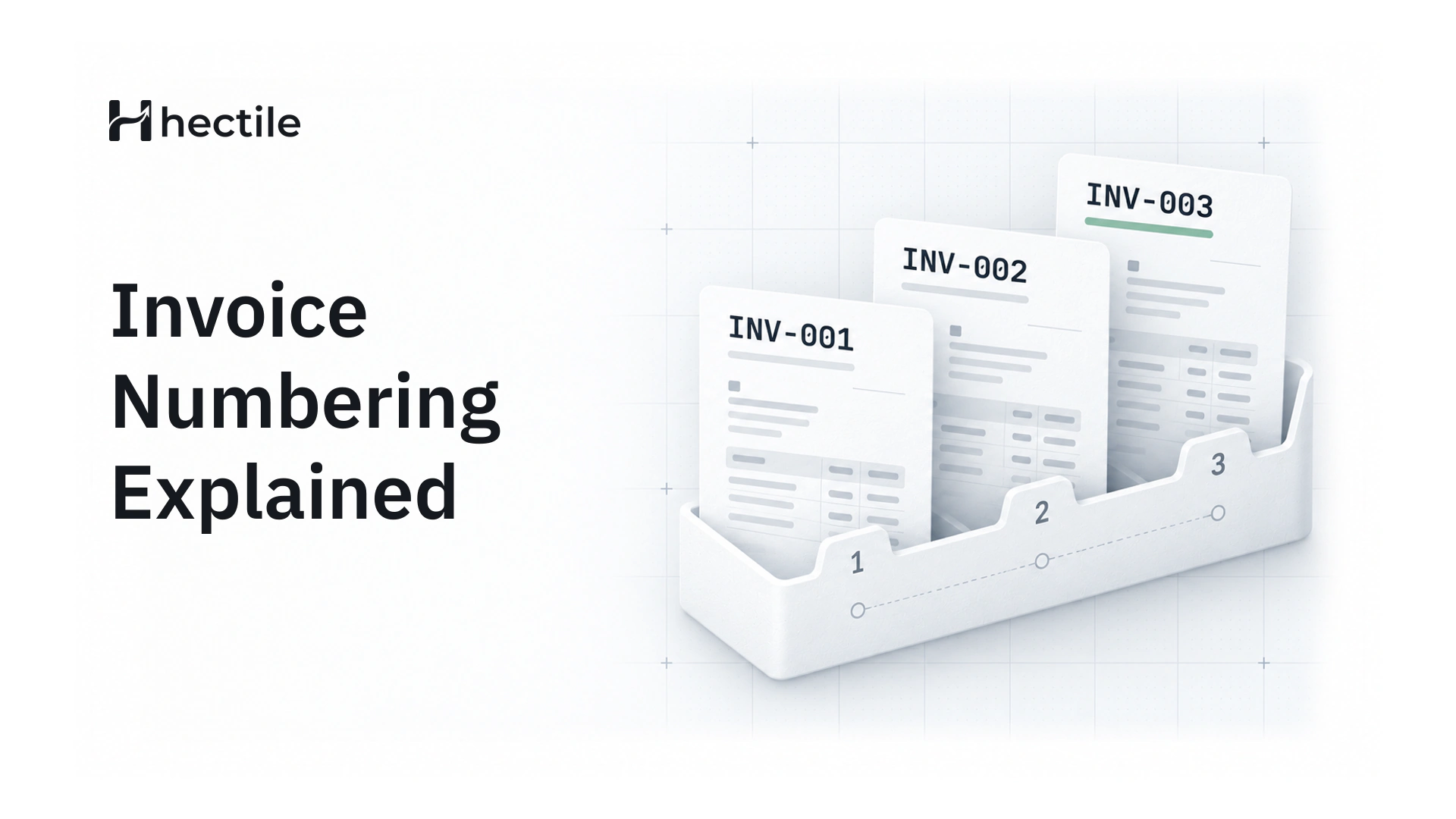
Invoice Numbering Explained: Formats, Rules and Mistakes to Avoid
Invoice numbers look like a detail until an accountant asks where number 47 went. Here's how to choose a format that stays clean for years.
Written by: Hectile TeamPublished 7 min read
In this article0% read
A few years into running her catering business, Priya's accountant asked a simple question during the annual review: "Where's invoice 0047?" There was a 46 and a 48, but no 47. It turned out she'd started an invoice, abandoned it and deleted the file. Nothing dishonest had happened, but it took a phone call, two emails and a written explanation to close the question.
That's the thing about invoice numbering. It feels like the least important part of an invoice, right up until someone needs it to be perfect. This guide covers the rules, the formats that work, and the small habits that keep your numbers clean for years.
Why invoice numbers matter
An invoice number does more work than it looks:
- It's how everyone finds the document. Your client's accounts team, your accountant and you will all refer to it by number.
- It's how payments get matched. Clients often put the invoice number in their bank transfer reference.
- It's part of your tax record. Many tax authorities expect invoices to be numbered in a unique, consecutive sequence.
- It shows a complete history. A clean sequence tells anyone reviewing your books that nothing is missing.
- It looks professional. "INV-2026-0142" says you have a system. "Invoice #3" on your hundredth job says you don't.
The basic rules of invoice numbering
Wherever you're based, these rules hold up:
- Every invoice gets a unique number. Never reuse one, even for a cancelled invoice.
- Numbers follow a sequence. Each new invoice gets the next number in its series.
- Assign the number when the invoice is issued, not when you start drafting it. That's how you avoid gaps from abandoned drafts.
- Keep the format consistent within a series.
- Separate series are fine, for example one per brand, as long as each series is itself consecutive and unique.
- Don't edit an issued invoice's number. If something is wrong, cancel the invoice and issue a new one.
Common invoice number formats
There's no single correct format. Here are the common ones and when each works:
| Format | Example | Works well for |
|---|---|---|
| Simple sequence | 0001, 0002 | Very small businesses with one series |
| Prefix and sequence | INV-0001 | Telling invoices apart from estimates |
| Prefix, year and sequence | INV-2026-0001 | Businesses that reset numbering each year |
| Financial year format | INV/26-27/001 | Indian businesses working by financial year |
| Brand prefix | HM-INV-000058 | Owners running more than one brand |
| Customer code | ACME-003 | Rarely a good idea on its own |
That last one deserves a warning. Numbering by customer feels tidy, but it breaks the idea of one consecutive sequence and makes "show me every invoice from March" harder than it should be. If you want the customer visible, put it in the reference field rather than in the number.
How to choose your format
Keep it short and readable
People will type your invoice number into bank references, emails and search boxes. Short and unambiguous beats clever. Avoid characters that look alike, such as O and 0, and avoid spaces.
Decide whether to reset each year
Resetting the sequence every calendar or financial year gives you numbers like INV-2026-0001. It keeps numbers short and makes it obvious which year an invoice belongs to. If you reset, include the year in the number, otherwise you'll end up with two different invoices called 0001.
Use one series per brand
If you run more than one trading name, give each its own prefix and sequence. Clients of one brand never see the numbering of another, and each brand's records stay complete on their own. We cover the bigger picture in our guide to invoicing for more than one brand.
Check your local tax rules
Some countries set specific requirements. In India, for example, a GST tax invoice number must be no more than 16 characters, can use letters, numbers, hyphens and slashes, and must be unique within the financial year. A format like "HM-INV-2026-27-000058" would be too long. Something like "HM/26-27-0058" fits comfortably. Our article on the GST invoice format in India goes through the other mandatory fields.
Three numbering systems that work
To make this concrete, here's how three different businesses might set things up.
A freelance designer
One brand, around ten invoices a month, no reason to reset. A simple prefix and a four-digit sequence does the job: INV-0001, INV-0002 and so on. Ten invoices a month gives her over 80 years before she runs out of four-digit numbers, so padding isn't a concern.
An agency with two brands
A marketing agency trades as Harbor Marketing and also runs a smaller video studio under a different name. Each brand gets its own prefix, HM-INV- and VS-INV-, and its own sequence. Clients of the video studio never see Harbor's numbering, and at year end each brand's invoices form an unbroken run of their own.
A retailer in India working by financial year
A supplier in Pune files GST returns by financial year, April to March. It resets numbering every financial year and includes the year in the number, giving invoices like PS/26-27-0001. The number stays well under GST's 16-character limit, and nobody can confuse an invoice from April 2026 with one from April 2027.
Mistakes to avoid
These are the numbering habits that cause trouble later:
- Numbering drafts. If you give a number to every invoice you start, every abandoned draft leaves a gap.
- Reusing a cancelled number. A cancelled invoice keeps its number forever. The replacement gets a new one.
- Two people picking numbers by hand. Sooner or later, both use the same number on the same day.
- Mixing estimates and invoices in one series. Estimates that are never accepted leave holes in your invoice sequence.
- Changing format halfway through the year without a clear reason, which makes reconciliation painful.
- Typing numbers into a template. The template doesn't know what you used last time. You have to remember, and eventually you won't.
What about gaps in the sequence?
Gaps happen for innocent reasons, but they're worth avoiding because each one needs explaining. The two biggest causes are numbering drafts that never get sent and deleting invoices that were sent.
The fix for the first is simple: don't give a document its number until you issue it. The fix for the second is to never delete an issued invoice. Cancel it instead, so it stays in your records with its number and a cancelled status. Anyone reviewing the sequence can see exactly what happened.
How Hectile handles invoice numbering
We built Hectile so numbering takes care of itself. Here's how it works in practice:
- Drafts have no number. You can create, edit and delete Drafts freely without touching the sequence.
- Finalizing assigns the next number. The number is allocated at the moment you finalize, so two teammates finalizing at the same time can't get the same one.
- Each brand has its own sequences for invoices and estimates. A new brand gets a default prefix from its initials, such as "ZS-INV-" and "ZS-EST-", which you can change.
- You choose the format. Set the prefix, how many digits to pad to, and whether numbers reset never, every calendar year or every financial year, with the year shown as 2026, 26 or a financial year like 2026-27.
- You can continue an existing sequence. If you're moving from another tool, set the number your next invoice should start from.
- Cancelled invoices keep their number, so your sequence always tells the full story.
The Help guide on invoices explains how Drafts, finalizing and cancelling work, and the features page shows numbering alongside everything else. If you're still creating your first invoices, start with how to write a professional invoice.
A quick numbering checklist
Before you settle on a format, check it against this list:
- Is it short enough to type into a bank reference?
- Does it include the year if you reset yearly?
- Does each brand have its own prefix?
- Does it meet any local limits, such as 16 characters for GST in India?
- Will numbers only be assigned when an invoice is issued?
- Is there exactly one place that decides the next number?
Frequently asked questions
What is an invoice number?
An invoice number is a unique identifier given to each invoice you issue, usually in a consecutive sequence. It lets you, your customer and your accountant find and refer to a specific invoice, and it's often required for tax records.
Can invoice numbers contain letters?
Yes. Most businesses use a prefix such as "INV-" or a brand code, and many include the year. Just keep the format consistent and check local rules. In India, for example, GST invoice numbers may use letters, numbers, hyphens and slashes, up to 16 characters.
Do invoice numbers have to be sequential?
In many countries, yes, or at least they're expected to be. Even where it isn't strictly required, a consecutive sequence is the easiest way to show your records are complete. You can run separate sequences, such as one per brand, as long as each one is consecutive.
Should I restart invoice numbers every year?
You can, and many businesses do, especially those working to a financial year. If you reset, include the year in the number so that invoices from different years can never share a number. If you prefer one continuous sequence, that's fine too.
What happens to the number when I cancel an invoice?
The cancelled invoice keeps its number and stays in your records marked as cancelled. You don't reuse that number. The corrected or replacement invoice gets the next number in the sequence.