GST Invoice Format in India: Mandatory Fields, CGST vs SGST vs IGST, With Examples
Every field a GST tax invoice needs, how to choose between CGST and SGST or IGST, and worked examples you can check your own invoices against.
Written by: Hectile TeamPublished 7 min read
In this article0% read
Ask any chartered accountant about the most common GST invoice problem they see from small businesses, and you'll rarely hear about anything complicated. It's usually something like a missing place of supply, an HSN code with the wrong number of digits, or IGST charged on a sale that never left the state. Small errors, but each one can hold up your customer's input tax credit, and your customer will let you know about it.
This guide covers the GST invoice format in India: the fields the law requires, how to decide between CGST and SGST or IGST, and worked examples you can compare your own invoices against.
What makes an invoice a GST tax invoice?
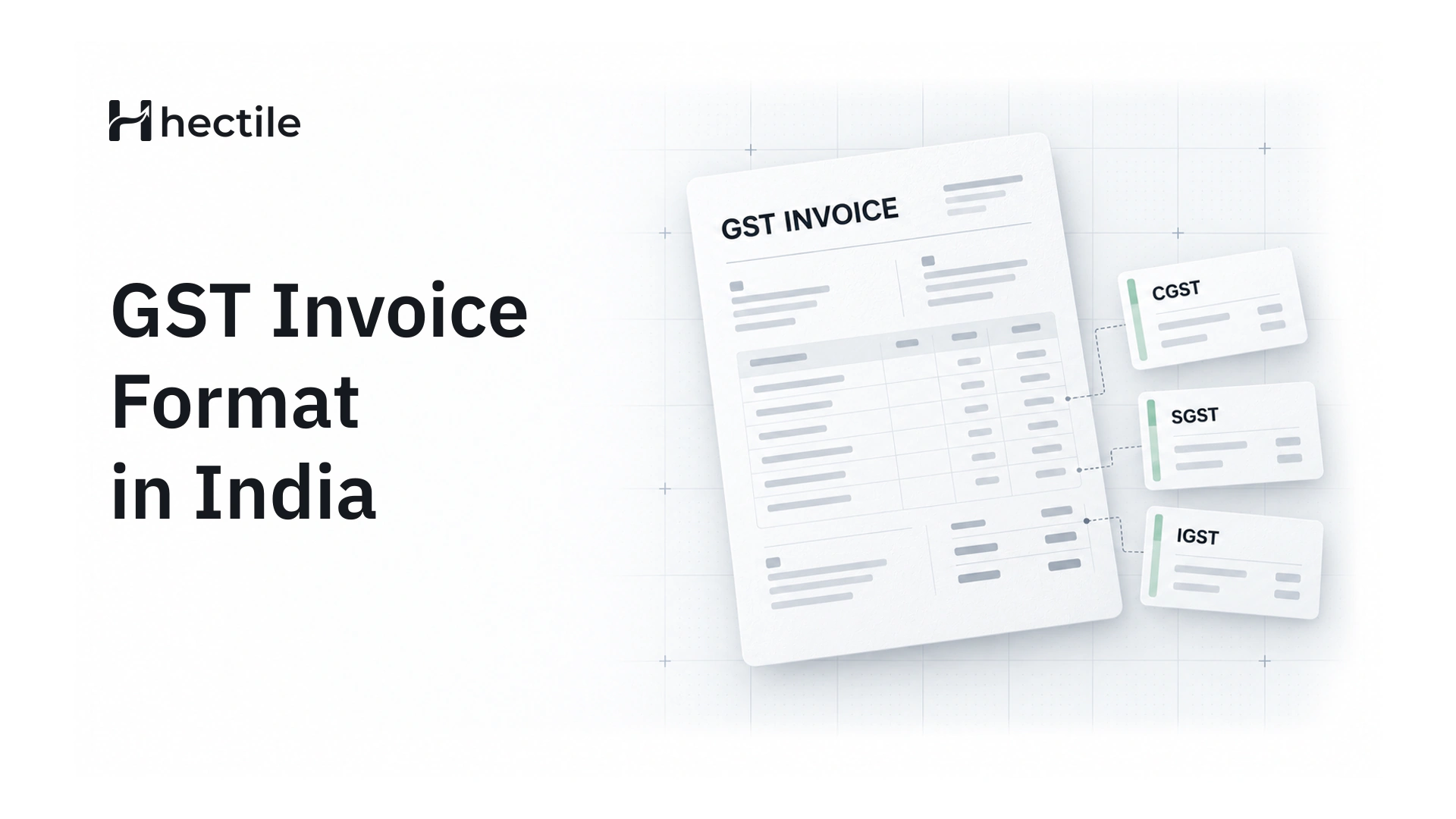
A tax invoice is the document a GST-registered supplier issues for a taxable supply. It's what allows your registered customer to claim input tax credit, so it has to contain specific particulars. Those are set out in Rule 46 of the CGST Rules, 2017.
If you're registered under the composition scheme, or you're supplying only exempt goods or services, you issue a bill of supply instead, which doesn't charge GST.
Mandatory fields on a GST tax invoice
Here's what a tax invoice needs, in plain language:
- Your name, address and GSTIN.
- A consecutive serial number of up to 16 characters, using letters, numbers, hyphens or slashes, unique for the financial year.
- The date of issue.
- Your customer's name, address and GSTIN, if they're registered.
- For unregistered customers with a taxable value of ₹50,000 or more, their name and address and the delivery address, with the state name and state code.
- The HSN code for goods or SAC code for services.
- A description of the goods or services.
- Quantity and unit, for goods.
- The total value of the supply.
- The taxable value, after any discount.
- The tax rate, shown separately for CGST, SGST or UTGST, IGST and cess where applicable.
- The tax amount for each of those taxes.
- The place of supply, with the state name, for inter-state supplies.
- The delivery address, if it's different from the place of supply.
- Whether tax is payable on reverse charge.
- Your signature or digital signature, or that of an authorised person.
How many HSN digits you need
The number of digits depends on your aggregate turnover in the previous financial year:
- Up to ₹5 crore: a 4-digit HSN code is mandatory on B2B invoices.
- Above ₹5 crore: a 6-digit HSN code is mandatory on all tax invoices.
Services use SAC codes in the same way.
Invoice number rules
The 16-character limit catches people out. A number like "BRIGHTLINE-INV-2026-0058" is too long. Keep a short prefix and, if you reset every financial year, a compact year, for example "BD/26-27-0058". Our guide to invoice numbering formats and rules has more examples.
CGST and SGST, or IGST?
This is the decision that trips up the most invoices, so here's the rule in one line: compare the supplier's location with the place of supply.
- Same state: it's an intra-state supply. Charge CGST and SGST, each at half the total rate. In a union territory without its own legislature, UTGST replaces SGST.
- Different states: it's an inter-state supply. Charge IGST at the full rate.
The place of supply isn't always where your customer's office is. For goods, it's generally where the goods are delivered. For services, it's generally the location of a registered recipient, though there are special rules for some services. When in doubt, check with your CA, because getting it wrong means the customer can't claim the credit and you'll need to correct the invoice.
Worked examples
Let's take a consultancy in Bengaluru, Karnataka, billing ₹50,000 for business process consulting at an illustrative GST rate of 18%.
Example 1: customer in Karnataka (intra-state)
| Line | Amount |
|---|---|
| Taxable value | ₹50,000.00 |
| CGST at 9% | ₹4,500.00 |
| SGST at 9% | ₹4,500.00 |
| Invoice total | ₹59,000.00 |
Example 2: customer in Maharashtra (inter-state)
| Line | Amount |
|---|---|
| Taxable value | ₹50,000.00 |
| IGST at 18% | ₹9,000.00 |
| Invoice total | ₹59,000.00 |
The total is the same. What changes is which tax is charged, and therefore which government receives it and how your customer claims the credit. The 18% here is only an example; use the rate that applies to your actual goods or services.
When to issue a GST invoice
Timing rules matter as much as the format:
- Goods: issue the invoice before or at the time of removal or delivery.
- Services: issue it within 30 days of supplying the service. Banks and some financial institutions get 45 days.
You'll also need copies. For goods, the convention is three: original for the recipient, duplicate for the transporter, triplicate for you. For services, two: original for the recipient and duplicate for you.
Other GST documents you may need
A tax invoice isn't the only document GST asks for. Depending on what you sell, you may also issue:
- A bill of supply, instead of a tax invoice, if you're under the composition scheme or the supply is exempt.
- A receipt voucher, when you receive an advance for services before issuing the invoice.
- A credit note, when you need to reduce the value of an invoice you've already issued, for example after a discount or a return.
- A debit note, when you need to increase it, for example after under-billing.
The rule of thumb is simple: never edit or delete an issued tax invoice. Adjust it with the right document, so your returns and your customer's input tax credit stay consistent. If customers pay you in stages, our guide to deposits, partial payments and balances covers how to keep each balance straight.
Keeping records
GST law expects you to keep your invoices and related records for several years after the relevant annual return. Practically, that means your invoices need to live somewhere searchable and permanent, not just in your sent mail. Ask your CA for the exact period that applies to you.
What about e-invoicing?
If your aggregate turnover has exceeded ₹5 crore in any financial year since 2017-18, B2B invoices must be reported to the government's Invoice Registration Portal. The portal returns an IRN and a QR code, which go on the invoice. If your turnover is ₹10 crore or more, the invoice must be reported within 30 days of its date, or the portal will reject it.
Below that threshold, a properly formatted tax invoice is enough. Hectile doesn't connect to the Invoice Registration Portal, so businesses above the threshold generate the IRN there as a separate step.
Common GST invoice mistakes
- Charging IGST on an intra-state sale, or CGST and SGST on an inter-state one.
- Missing or short HSN and SAC codes.
- An invoice number longer than 16 characters.
- No place of supply on an inter-state invoice.
- Leaving out the customer's GSTIN, so they can't claim credit.
- Adding GST to a price that already included it.
- Editing an issued invoice instead of issuing a credit note or a corrected document.
How Hectile helps with GST invoices
Hectile doesn't decide your tax treatment. That's your call, or your CA's. What it does is make sure your invoices carry the right details every time, once you've set them up:
- Tax profiles you create once, such as "GST 18% intra-state" with CGST and SGST components, or "IGST 18%", applied as tax-exclusive or tax-inclusive.
- Your GSTIN from your Organization's details, and your customer's GSTIN from their saved record.
- HSN or SAC codes saved against your items and services, so they appear on each line.
- Place of supply on the document, and reverse charge noted where your tax profile applies it.
- Numbering per brand, with an optional financial-year format that stays within the 16-character limit.
- Clear breakdowns, with each tax component shown separately with its rate and amount.
You can see a sample on the GST invoice generator for India page, and the Help guide to taxes and tax profiles explains tax-exclusive and tax-inclusive pricing with worked arithmetic. If you're putting together your first invoices, our general guide on how to write a professional invoice covers the presentation side.
Frequently asked questions
What is the format of a GST invoice?
A GST tax invoice must include the supplier's name, address and GSTIN, a unique serial number of up to 16 characters, the date, the recipient's details (and GSTIN if registered), HSN or SAC codes, a description, quantity, taxable value, tax rates and amounts for each tax, the place of supply for inter-state supplies, the reverse charge status and a signature. There's no single mandatory layout, as long as these particulars are present.
When should I charge IGST instead of CGST and SGST?
Charge IGST when the supplier's location and the place of supply are in different states or union territories. Charge CGST and SGST, each at half the rate, when both are in the same state. The place of supply rules decide which applies, so it isn't always the customer's billing address.
Is HSN code mandatory on every GST invoice?
It depends on turnover. If your aggregate turnover in the previous year was up to ₹5 crore, a 4-digit HSN code is mandatory on B2B invoices. Above ₹5 crore, a 6-digit HSN code is mandatory on all tax invoices. Services use SAC codes the same way.
Do small businesses need e-invoicing under GST?
Only if aggregate turnover has exceeded ₹5 crore in any financial year since 2017-18. Below that, a correctly formatted tax invoice is enough. Above it, B2B invoices must be reported to the Invoice Registration Portal for an IRN and QR code.
Can I issue a GST invoice in a foreign currency?
You can bill an overseas customer in their currency, which is common for exports of services. Your records and returns will still need the value in rupees, so keep the exchange rate you used. Hectile lets you choose a document's currency, with the customer's preferred currency used as the default.