Deposits, Partial Payments and Balances: How to Track What Clients Still Owe
A deposit here, an instalment there, and suddenly nobody's sure what's still owed. Here's how to bill and record part payments so the balance is never a guess.
Written by: Hectile TeamPublished 7 min read
In this article0% read
- Why partial payments get confusing
- Deposits, partial payments and instalments
- Two ways to bill a deposit
- Setting deposit and instalment terms up front
- How to record a partial payment properly
- Reading the balance: invoice statuses
- Handling the awkward cases
- What the invoice should show
- How Hectile tracks partial payments
- Frequently asked questions
A furniture maker we know took a 50% deposit on a custom dining table, then agreed to let the customer pay the rest in two instalments. Simple enough. Except the first instalment arrived short by 350 because of bank charges, the second was paid partly in cash at delivery, and three months later neither side could say with confidence what was still owed. The relationship survived. The weekend spent going through bank statements was not fun.
Partial payments are normal. Deposits protect you before work starts, instalments help customers manage big purchases, and part payments happen when budgets get tight. The trouble isn't the payments themselves. It's tracking them. This guide covers how to bill deposits, how to record each payment, and how to make sure the balance due is always right.
Why partial payments get confusing
The same few things cause most of the confusion:
- Payments arrive in odd amounts. Bank charges, rounding or a customer paying "what they can this month".
- They arrive by different methods. A bank transfer, then UPI, then cash.
- Records live in different places. The invoice in one tool, payments in a bank app, notes in a spreadsheet.
- The invoice doesn't change. A PDF sent in March still shows the full amount in May.
- Several people are involved. One person records a payment; another sends a reminder for the full amount.
Deposits, partial payments and instalments
These terms get used loosely, so it helps to separate them:
Deposit
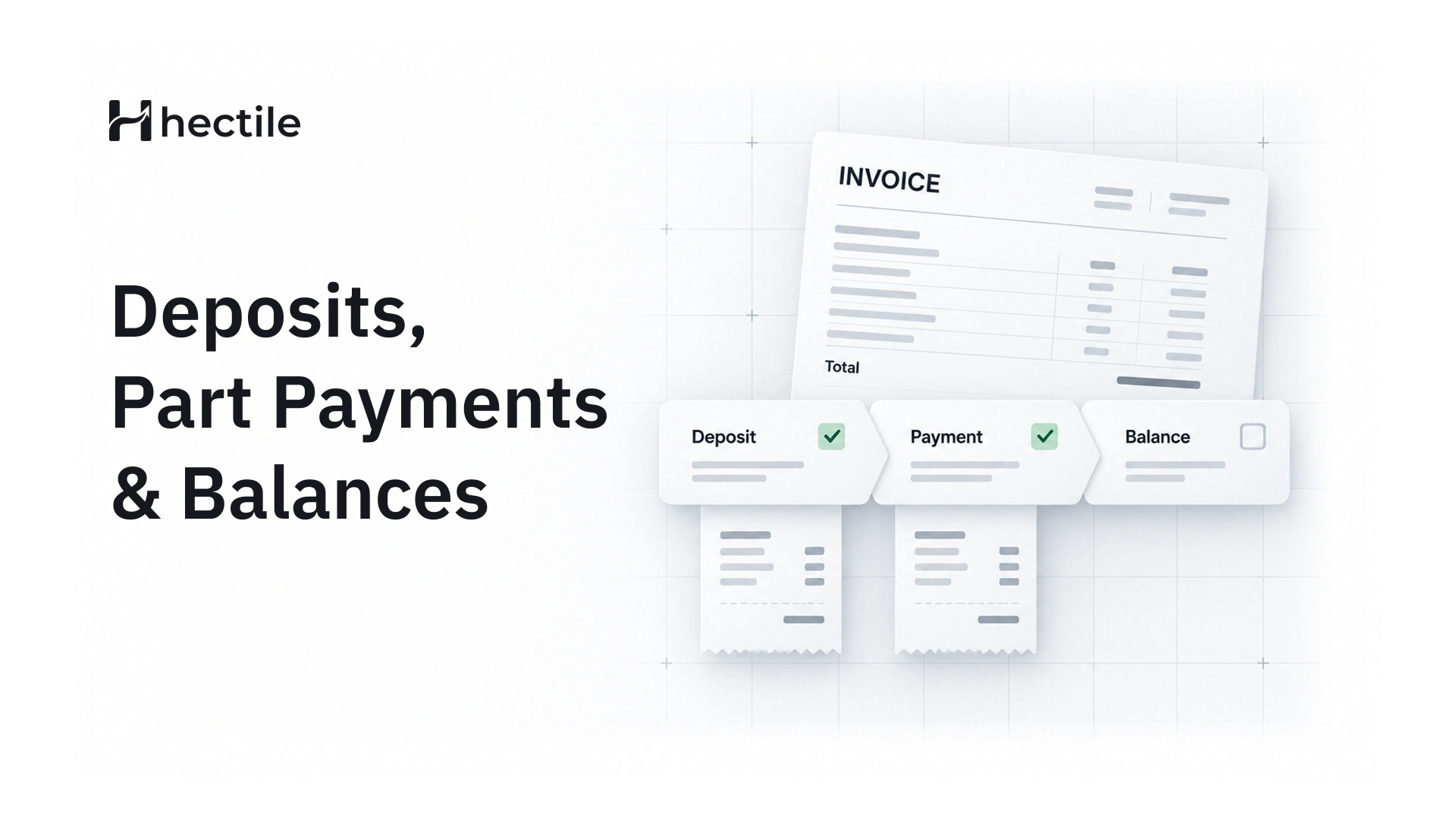
A deposit is money paid before work starts or goods are made, usually a fixed percentage such as 30% or 50%. It shows commitment and covers your early costs.
Partial payment
A partial payment is any payment that covers less than the full invoice. It might be planned or unplanned.
Instalment plan
An instalment plan is an agreed schedule of partial payments, such as three equal monthly payments. Each instalment is planned in advance, with its own amount and date.
Two ways to bill a deposit
There are two common approaches, and both are legitimate.
Option 1: a deposit invoice, then a final invoice
You issue one invoice for the deposit, then a second for the balance once the work is done. The final invoice bills the remaining amount and refers to the deposit invoice.
This approach is clean for tax purposes, because each invoice records exactly what was billed at that point. It's the usual choice where tax rules say you must invoice when you receive an advance.
Option 2: one invoice, several payments
You issue a single invoice for the full amount and record each payment against it as it arrives: the deposit, then the rest. The invoice shows the amount paid so far and the balance still due.
This approach is simpler to follow for the customer, because there's only ever one document to refer to.
| Deposit invoice plus final invoice | One invoice, several payments | |
|---|---|---|
| Documents | Two or more | One |
| Clear for tax timing | Very | Depends on local rules |
| Easy for the customer to follow | Good | Very good |
| Best for | Projects with distinct stages | Instalments on one sale |
If you're not sure which suits your tax situation, ask your accountant once and then stick with it. We cover how estimates lead into deposit and final invoices in our guide to invoice vs estimate vs quotation.
Setting deposit and instalment terms up front
Most disputes about part payments start because the terms were never written down. Agree them before the work begins, ideally in the estimate or quote, so the invoices simply follow what was already accepted. Your terms should cover:
- The deposit amount, as a percentage or a fixed sum.
- When the deposit is due, for example before work is scheduled or materials are ordered.
- What happens to the deposit if the job is cancelled, and whether any of it is refundable.
- The instalment schedule, with amounts and dates.
- What happens if an instalment is late, such as pausing work or applying a late fee you've agreed.
Here's what a simple instalment schedule might look like for a project worth 9,000:
| Payment | When | Amount |
|---|---|---|
| Deposit, 40% | On acceptance | 3,600 |
| Instalment 1 | At the halfway milestone | 2,700 |
| Instalment 2 | On delivery | 2,700 |
| Total | 9,000 |
Put the same table in the estimate and refer to it on each invoice. When the customer's finance team asks why they're paying 2,700, the answer is already on paper.
How to record a partial payment properly
Every payment deserves the same short routine:
- Record the amount actually received, not the amount you expected.
- Record the date the money arrived.
- Record the method, such as bank transfer, UPI, card, cash or cheque.
- Add the reference, such as the bank's transfer reference, the UPI transaction ID or the cheque number. It makes later reconciliation far easier.
- Add a note if anything is unusual, for example "short by 350 due to bank charges, agreed to waive".
- Check the new balance and make sure it matches what you expect.
Do it the day the money arrives. Recording payments a week later, from memory, is how balances drift.
Reading the balance: invoice statuses
An invoice's status should tell you where things stand at a glance:
- Unpaid: nothing received yet.
- Partially paid: some money received, a balance remains.
- Paid: the balance is zero.
- Overdue: the due date has passed and a balance remains, whether that's the full amount or part of it.
When you send a reminder, quote the remaining balance, not the original total. Asking for the full amount after someone has paid half is the fastest way to irritate a good customer. Our payment reminder email templates are written with that in mind.
Handling the awkward cases
A customer pays more than they owe
It happens: a duplicate transfer, or an instalment paid twice. Don't record more than the balance against the invoice. Record what settles it, then agree with the customer whether to refund the difference or put it towards a future invoice, and note what you agreed.
Bank charges reduce the amount
International transfers often arrive slightly short. Decide on a policy: either ask the customer to cover charges, which should be stated in your terms, or accept small differences and note them. Either way, record the amount actually received.
A payment was recorded by mistake
Never delete it silently. Void the payment so the balance is corrected but the record of what happened stays, with a reason. Anyone reviewing the invoice later can see the full story.
Several invoices paid in one transfer
Some customers settle three or four invoices with a single payment. Split it across the invoices it covers, one payment record per invoice, each with the same bank reference. That way every invoice shows its own correct balance, and the reference ties them all back to the one transfer when you reconcile your bank statement.
What the invoice should show
When a customer has paid part of an invoice, the document they see should make the position obvious:
- the invoice total
- the amount paid so far
- the balance due
- the due date for the remaining balance
- how to pay it
How Hectile tracks partial payments
Hectile was built so the balance is never a guess. You record each payment against the invoice with its amount, date, method, an optional reference and an optional note. Methods include bank transfer, UPI, card, cash, cheque and digital wallets, with reference hints such as the UTR or UPI transaction ID.
The invoice updates as you go, from Unpaid to Partially Paid to Paid, and shows Overdue if a balance remains after the due date. Recording more than the balance is prevented, so an invoice can't be overpaid by mistake. A payment recorded in error can be voided, which corrects the balance while keeping the history. If you've turned on payment receipts, your customer gets a receipt for each payment, and automatic reminders always quote the current balance due.
The Help guide to payments walks through recording and voiding in detail, and invoicing for freelancers shows how deposits fit into project work. If you're setting up invoices for the first time, start with how to write a professional invoice.
Frequently asked questions
How do I show a partial payment on an invoice?
Record the payment against the invoice rather than editing the invoice itself. The invoice should then show the total, the amount paid so far and the remaining balance due. In Hectile, the status changes to Partially Paid and the balance updates automatically.
Should a deposit have its own invoice?
It can. A separate deposit invoice followed by a final invoice is clean for tax records and common for staged projects. Alternatively, one invoice with several payments recorded against it is simpler for the customer. Check which suits your tax rules, then use it consistently.
What should I do if a client overpays an invoice?
Record only the amount that settles the invoice, then agree with the client whether to refund the extra or apply it to a future invoice. Make a note of what you agreed, so your records and theirs stay in step.
Can I record payments made in cash or by UPI?
Yes. A payment record should note the method, whether that's cash, UPI, bank transfer, card or cheque, along with any reference, such as the UPI transaction ID or cheque number. Hectile includes all of these methods, with a reference field suited to each.
How do I correct a payment I recorded by mistake?
Void it rather than deleting it. Voiding removes the payment from the balance but keeps a record that it was entered and corrected, with a reason. That way your history stays complete for you, your client and your accountant.