12 Invoicing Habits That Help Freelancers Get Paid Faster
Getting paid on time is mostly habit. Twelve small things freelancers can do before, during and after invoicing that make late payments the exception.
Written by: Hectile TeamPublished 7 min read
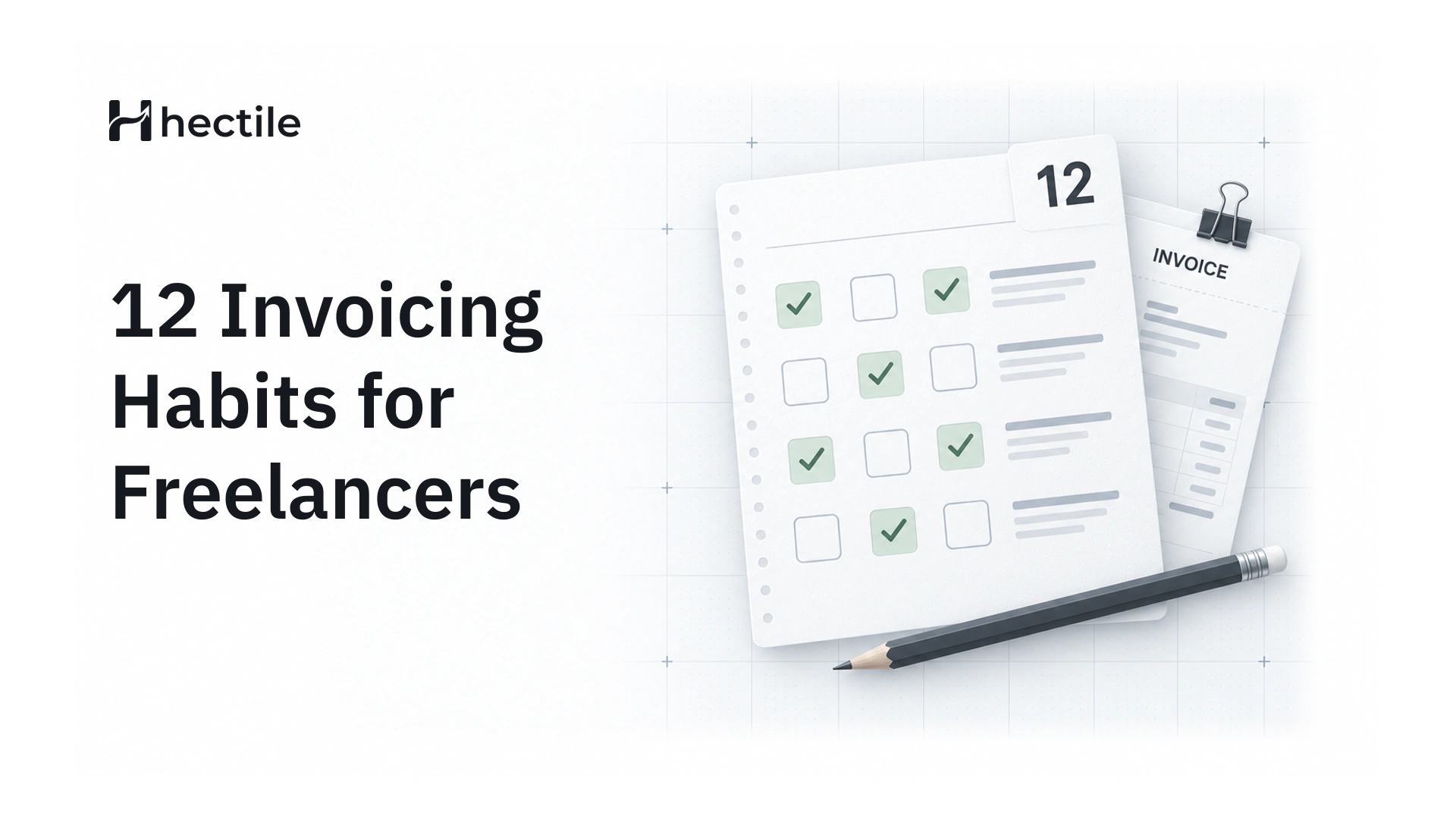
Ask a room of freelancers about late payments and you'll hear the same stories: the client who "never received" the invoice, the 30-day terms that became 75, the awkward chase that soured a good relationship. Ask the freelancers who rarely have those stories what they do differently, and the answer is almost never one big trick. It's a handful of small, boring habits, done every time.
Here are twelve of them, in the order you'd use them: before the work starts, when you invoice, and after you've sent it. You don't need all twelve at once. Pick the three that would have prevented your last late payment and start there.
Before the work starts
1. Agree payment terms in writing
"Payment within 15 days of invoice" in an email the client replies to is worth more than any reminder you'll send later. Put your terms in your estimate or quote, including when payment is due, how you'll be paid and what happens if a payment is late. When the invoice arrives, it simply follows what was already agreed.
2. Take a deposit on anything substantial
For larger projects, ask for 30 to 50% up front. A deposit confirms the client is serious, covers your early time, and shifts the risk of a project going quiet halfway through. Clients who hesitate at a deposit are telling you something useful. Our guide to deposits, partial payments and balances covers how to bill and record them.
3. Find out who actually pays
Your day-to-day contact often isn't the person who approves invoices. Ask three questions at the start of every new client relationship:
- Who should invoices be sent to, and at which email address?
- Do you need a purchase order number or reference on the invoice?
- When does your company run payments?
Some companies pay only twice a month, and missing the cut-off adds two weeks.
When you invoice
4. Invoice the day you deliver
The longer you wait to invoice, the longer you wait to be paid, and the more the work fades from the client's memory. Make invoicing part of delivery: finish the work, send the files, send the invoice. For ongoing clients, a recurring invoice does it on schedule without you.
5. Write descriptions a stranger would understand
"Design work" invites a question from finance. "Homepage redesign, two revision rounds, delivered 12 October" doesn't. Specific descriptions get approved faster, because nobody has to email you to ask what they're paying for.
6. Keep payment terms short
Unless a client insists on longer, use due on receipt, or 7 to 15 days. Shorter terms aren't rude; they're normal for freelance work. And put an actual date on the invoice, not just "Net 15", so nobody has to count.
7. Make paying effortless
Every extra step is a reason to put your invoice down for later. Make sure every invoice includes:
- your bank details or UPI ID, laid out clearly
- the reference you'd like the client to use, usually the invoice number
- the exact amount due, and the date it's due
- a link to the invoice as well as the PDF, so it opens on a phone
The goal is that a client can pay in two minutes without writing back to ask anything.
8. Number every invoice properly
A unique, consecutive number makes your invoice easy to find, easy to match to a payment, and easy to chase. It also keeps your records clean for tax time. If you're unsure what format to use, see our guide to invoice numbering formats and rules.
After you send it
9. Confirm it arrived
A short "just confirming you received this" the next day catches the invoice that went to spam, the old email address and the contact who's on leave. If you send a secure link, you can often see when it's been opened, which saves you the question.
10. Remind before the due date, not after
A friendly note three days before the due date is the most effective reminder you'll ever send, because nobody's late yet and nobody needs to feel awkward. Our payment reminder email templates include one for exactly this moment.
11. Record payments the day they land
When money arrives, record it against the invoice straight away, with the date and the transfer reference. If you leave it for "admin day", you'll eventually remind a client who has already paid, and that's a much worse email to write than any overdue reminder.
12. Review what's outstanding every week
Pick a time, say Friday morning, and spend ten minutes on money. Look at three things: what's overdue, what falls due next week, and what work you've finished but haven't billed. It's the habit that makes the other eleven stick, because it catches whatever slipped through during a busy week.
A ten-minute weekly money routine
Here's a simple routine for that weekly check:
- Open your list of unpaid invoices, sorted by due date.
- Record any payments that arrived this week.
- Send a friendly reminder for anything due in the next few days.
- Follow up anything overdue, by email or a quick call.
- Invoice any work you finished this week but haven't billed yet.
- Note anything unusual, such as a client asking to pay in parts.
Ten minutes a week is far less painful than an afternoon of chasing at the end of the month.
Three late payments, and the habit that would have stopped each
Most late payments trace back to one missing habit. Three stories from freelancers we've spoken to:
The invoice that sat in the wrong inbox. A copywriter sent every invoice to her contact in marketing, who forwarded them to finance whenever she remembered. Payments averaged 40 days on 15-day terms. Habit 3 fixed it: one question at the start of the project, "who should invoices go to?", and payments dropped to 16 days.
The month-end batch. A developer invoiced all his clients on the last day of each month, even for work finished on the 3rd. Some invoices were effectively four weeks late before they were even sent. Habit 4, invoicing on delivery, brought his cash in a month earlier without a single reminder.
The forgotten deposit. A designer agreed a 50% deposit on a branding project but never invoiced it, then started work anyway. When the client paused the project halfway, she had nothing to show for three weeks of work. Habits 2 and 4 together would have meant the deposit was invoiced, and paid, before the first sketch.
Common habits that slow payment down
A few habits work against you, even with good intentions:
- Invoicing in batches at month end, which adds up to four weeks to every payment.
- Vague "per our discussion" descriptions that need explaining.
- Waiting until an invoice is very late before mentioning it.
- Keeping payment records in your head, or in your banking app alone.
- Reusing an old invoice as a template, which is how wrong dates and wrong amounts go out.
Let your tools carry the routine
Most of these habits are easy to keep for a month and hard to keep for a year, because they rely on remembering. That's where invoicing software earns its place. In Hectile, for example:
- estimates carry your terms, and an accepted estimate becomes an invoice draft without retyping
- every invoice gets the next number when you finalize it
- invoices go out by email with a PDF and a secure link, and you can see when the link is opened
- automatic reminders go out before and after the due date, and skip invoices that have been paid
- recurring invoices handle retainers on schedule
- payments, including deposits and part payments, are recorded against each invoice so the balance is always right
The invoicing for freelancers page shows how it fits project work, and the estimate generator shows how terms and deposits start in the estimate. If you're putting your first invoices together, start with how to write a professional invoice.
Frequently asked questions
How can freelancers get paid faster?
Agree payment terms before you start, take a deposit on larger jobs, invoice the day you deliver, keep terms short, make paying easy with clear details and a link, and send a friendly reminder a few days before the due date. Consistency matters more than any single trick.
What payment terms should a freelancer use?
Due on receipt, or 7 to 15 days, suits most freelance work. Larger companies may ask for 30 days or more; if so, agree it before you start and put the exact due date on every invoice. For big projects, combine terms with a deposit up front.
Should freelancers ask for a deposit?
For anything substantial, yes. A deposit of 30 to 50% is common. It confirms the client's commitment, covers your early time and reduces the risk of unpaid work if a project stalls. State the deposit in your estimate so it's agreed before work begins.
When should a freelancer send an invoice?
As soon as the work, or the agreed milestone, is delivered. Every day you wait is a day added to your payment. For ongoing monthly work, a recurring invoice on a fixed date keeps billing predictable for both sides.
What should I do if a client pays late?
Start with a polite reminder that quotes the invoice number, amount and due date. Follow up weekly, then call. If it's still unpaid, offer a payment plan, apply any late fee you agreed in your terms, and pause further work until it's settled.