Invoice vs Estimate vs Quotation: What's the Difference and When to Use Each
Three documents that look alike but promise very different things. Here's what each one means, when to send it, and how to move from one to the next cleanly.
Written by: Hectile TeamPublished 7 min read
In this article0% read
- The short answer
- What is an estimate?
- What is a quotation?
- What is an invoice?
- Estimate vs quotation: the differences that matter
- When to use each
- From estimate to invoice without retyping
- A worked example: one job, three documents
- What every estimate or quote should include
- Common mistakes
- Frequently asked questions
A builder we know once sent a homeowner an "estimate" for a kitchen renovation. The homeowner read it as a fixed price. When the final bill came in 15% higher, because the old wiring had to be replaced, the conversation turned sour fast. Neither of them was being unreasonable. They just meant different things by the same word.
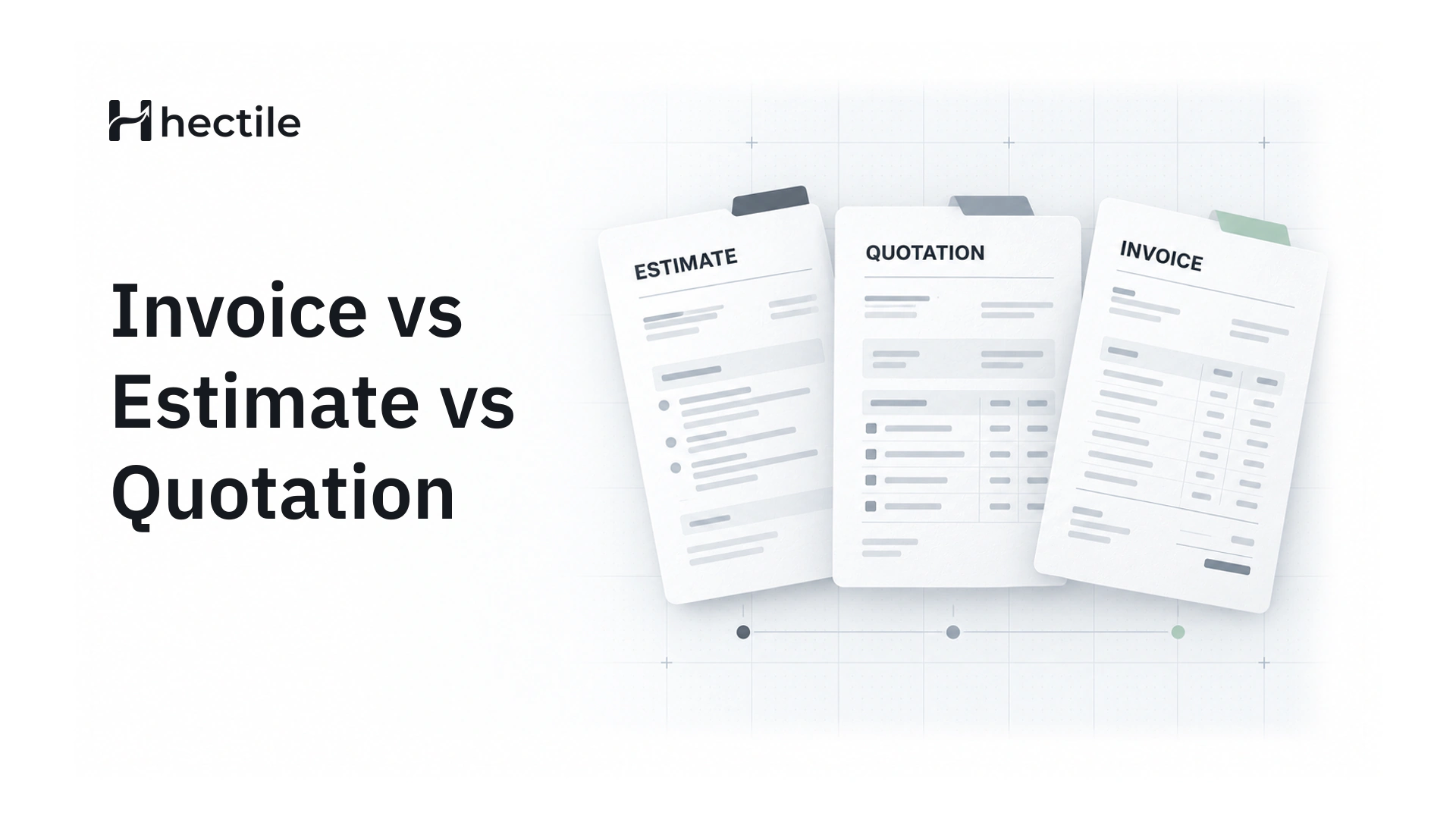
Estimates, quotations and invoices look alike. They all list work, prices and a total. But each one makes a different promise, and mixing them up causes most of the "that's not what we agreed" moments small businesses run into. Here's how they differ, when to use each, and how to move from one to the next without retyping anything.
The short answer
| Document | When you send it | How firm is the price? | What happens next |
|---|---|---|---|
| Estimate | Before the work, when scope may change | An informed approximation | Customer accepts, declines or asks for changes |
| Quotation | Before the work, when scope is clear | A fixed offer for a set period | Customer accepts, and the price holds |
| Invoice | When payment is due | Final and exact | Customer pays, and you record it |
If you remember only one thing: estimates and quotes come before the work and ask for agreement. Invoices come after agreement and ask for payment.
What is an estimate?
An estimate is your best informed guess at what a job will cost. It's useful when you can't know everything up front: how many hours a website migration will take, or what a renovation will uncover once the walls are open.
A good estimate still has detail. It breaks the work into lines, shows quantities and rates, and states its assumptions plainly. It also has a validity date, the date after which you'd want to review the prices again.
The key point is that an estimate leaves room for change, and the customer should understand that. If the actual cost is likely to move, say by how much and why.
What is a quotation?
A quotation, or quote, is a firmer offer: this work, at this price, if you accept by this date. Quotes are common when the scope is well defined, for example supplying 40 office chairs, installing a point-of-sale system in two locations, or a fixed-fee consulting engagement.
Because a quote is a firm offer, it needs to be precise:
- exactly what's included, item by item
- exactly what isn't included
- the price, with tax shown
- how long the price holds
- payment terms, including any deposit
Many businesses use "estimate" and "quotation" interchangeably, and in everyday use that's mostly fine. What matters is that the document itself makes clear how firm the price is. In Hectile, for instance, quotations use the same workflow as estimates: you set a Valid until date and the document records whether the customer accepted or declined.
What is an invoice?
An invoice is a request for payment for work that's been agreed, and usually delivered. Unlike an estimate or quote, it's also a financial record. It carries a unique number in a sequence, the exact amounts, any tax, and the date payment is due. Your accountant and, depending on where you are, your tax authority will treat it as the official record of the sale.
That's why invoices shouldn't change once they're issued. Estimates can be revised and re-sent. Invoices, once out, should be cancelled and replaced if something's wrong, never quietly edited.
Estimate vs quotation: the differences that matter
People search for "estimate vs quotation" more than any other pairing, so it's worth spelling out:
- Certainty. A quote says "this is the price". An estimate says "this is roughly the price".
- Commitment. An accepted quote is generally treated as binding on both sides. An estimate gives more room, as long as you communicate changes.
- Detail. Quotes tend to be more precise about exactly what's included and excluded.
- Validity. Both should have a date after which the prices need review, but it matters more for a quote, because you're committing to the number.
Whether either is legally binding depends on your contract and where you operate, so for large jobs it's worth putting the key terms in writing alongside the document.
When to use each
Use an estimate when the scope might move
Repairs, renovations, discovery work, or any project where you'll learn more once you start. Send an estimate, explain your assumptions and agree how changes will be handled.
Use a quotation when the scope is clear
Product supply, fixed-fee packages and installations with a known specification. A quote gives the customer certainty, and certainty helps them say yes.
Send an invoice when payment is due
After delivery, at agreed milestones, or up front for a deposit. If you're billing a deposit, the invoice should say so clearly, so the later invoice for the balance makes sense. We cover that in our guide to deposits, partial payments and balances.
From estimate to invoice without retyping
The most error-prone moment is the hand-off: the estimate is accepted, and someone copies the lines into an invoice by hand. Prices change, a line goes missing, the reference gets lost.
A cleaner flow looks like this, and it's the one Hectile follows:
- Send the estimate with a clear validity date, as a PDF or a secure link.
- Record the customer's decision. The customer can accept or decline from the link, or a team member records the reply they got by email.
- Create the invoice from the estimate. The lines, customer and reference carry across into a new Invoice Draft.
- Review the Draft. Adjust anything that changed during the job, such as an extra revision round or a reduced quantity.
- Finalize the invoice. It gets its official number, and the estimate now shows as Converted, so you can see the job went all the way through.
If an estimate passes its validity date without a decision, it shows as Expired. It stays in your records, and you can always send a fresh one.
You can see this flow on the estimate generator page, or the quotation generator if you mostly quote for products. The Help guide to estimates walks through each status.
A worked example: one job, three documents
It helps to see the documents side by side on a real job. Say a small web studio, Clearpath, is asked to redesign a client's website.
Week 1, the estimate. Clearpath doesn't yet know how messy the old site's content is, so it sends an estimate, EST-0021, for USD 6,000: discovery at 1,000, design at 3,000 and build at 2,000. It notes that content migration is excluded and that the estimate is valid for 30 days.
Week 2, the decision. The client accepts from the estimate's link. Nothing is billed yet. The estimate simply shows as accepted, and Clearpath now has written agreement on scope and price.
Week 3, the deposit invoice. The terms say 50% up front, so Clearpath creates an invoice from the estimate and adjusts it to a single line: "Deposit, 50% of EST-0021". The invoice goes out for USD 3,000 and the client pays by bank transfer.
Week 8, the final invoice. The client asked for one extra page halfway through, agreed by email at USD 400. The final invoice bills the remaining 50% of the estimate plus the extra page, USD 3,400 in all, with a note referring to the deposit invoice so the client's finance team can see how the full USD 6,400 adds up.
Notice what made this smooth. The estimate set expectations, the acceptance was recorded, and each invoice could be traced back to the agreed numbers. If the client's finance team asks why the final total is higher than the estimate, the answer is right there on the page.
What every estimate or quote should include
Whichever you send, these details save arguments later:
- a clear scope in plain language
- what's excluded, such as travel, materials or third-party costs
- quantities, rates and the total, with tax shown separately
- a validity date
- payment terms and any deposit
- a reference the customer can quote back to you
Common mistakes
- Sending an estimate with no validity date, then being held to the price a year later.
- Calling something a quote when the price is really an estimate.
- Retyping an accepted estimate into an invoice and changing a number by accident.
- Forgetting to mention that tax is extra.
- Losing track of which estimates were accepted, so work starts without written agreement.
Once the invoice is ready, our step-by-step guide on how to write a professional invoice covers the details that get it approved on the first try.
Frequently asked questions
Is an estimate legally binding?
Generally, an estimate is treated as an approximation rather than a firm promise, but that depends on your contract terms and local law. If the final price is likely to differ, say so in writing and agree how changes will be approved. For large projects, put the key terms in a short agreement as well.
Can an estimate become an invoice?
Yes, and it should, so you don't retype anything. In Hectile, once an estimate is accepted you create an invoice from it. The lines carry across into a new Draft you can review before finalizing, and the estimate is marked Converted once the invoice is issued.
What is a pro forma invoice?
A pro forma invoice is a preliminary bill sent before the work or delivery, often so the customer can arrange payment or import paperwork. It isn't a tax invoice and isn't recorded as a sale. In practice, many small businesses use an estimate or quote for the same purpose.
How long should a quotation be valid?
Thirty days is common, but choose a period that matches how stable your costs are. If your material prices move quickly, keep it short, perhaps 7 to 14 days. Always put the date on the document itself, not just in an email.
Should estimates have their own numbers?
Yes. Give estimates their own sequence, separate from invoices, so a customer can quote "EST-0021" and you know exactly which offer they mean. Hectile numbers estimates and invoices separately for each brand, with a default prefix for each.