UAE VAT Invoice Requirements: What a Tax Invoice Must Include
The details every UAE tax invoice needs, when a simplified invoice will do, how to handle foreign currencies, and what e-invoicing changes from 2027.
Written by: Hectile TeamPublished 7 min read
In this article0% read
- Who has to issue a tax invoice?
- What a full UAE tax invoice must include
- When a simplified tax invoice is enough
- Full or simplified: which should you use?
- The 14-day rule
- Worked example
- Corrections: tax credit notes
- E-invoicing is coming: what changes and when
- Common UAE VAT invoice mistakes
- How Hectile helps with UAE VAT invoices
- Frequently asked questions
A marketing agency in Dubai we spoke to lost three weeks on a single invoice last year. Their client's finance team rejected it because it was billed in US dollars with no VAT amount shown in dirhams. The agency had charged the right VAT. It just hadn't stated it the way the rules require, so the client couldn't recover it.
That's typical of UAE VAT invoice problems. The tax itself is simple: 5% on most supplies. The paperwork is where small details matter. This guide covers what a tax invoice must include, when a simplified invoice is enough, how to deal with foreign currencies, and what the coming e-invoicing rules mean for small businesses.
Who has to issue a tax invoice?
If your business is registered for VAT in the UAE and makes a taxable supply, you must issue a tax invoice. The requirements are set out in Article 59 of the VAT Executive Regulations. There are two kinds:
- a full tax invoice, the standard version with every required detail
- a simplified tax invoice, a shorter version allowed in specific situations
If you're not registered for VAT, you shouldn't issue tax invoices or charge VAT at all.
What a full UAE tax invoice must include
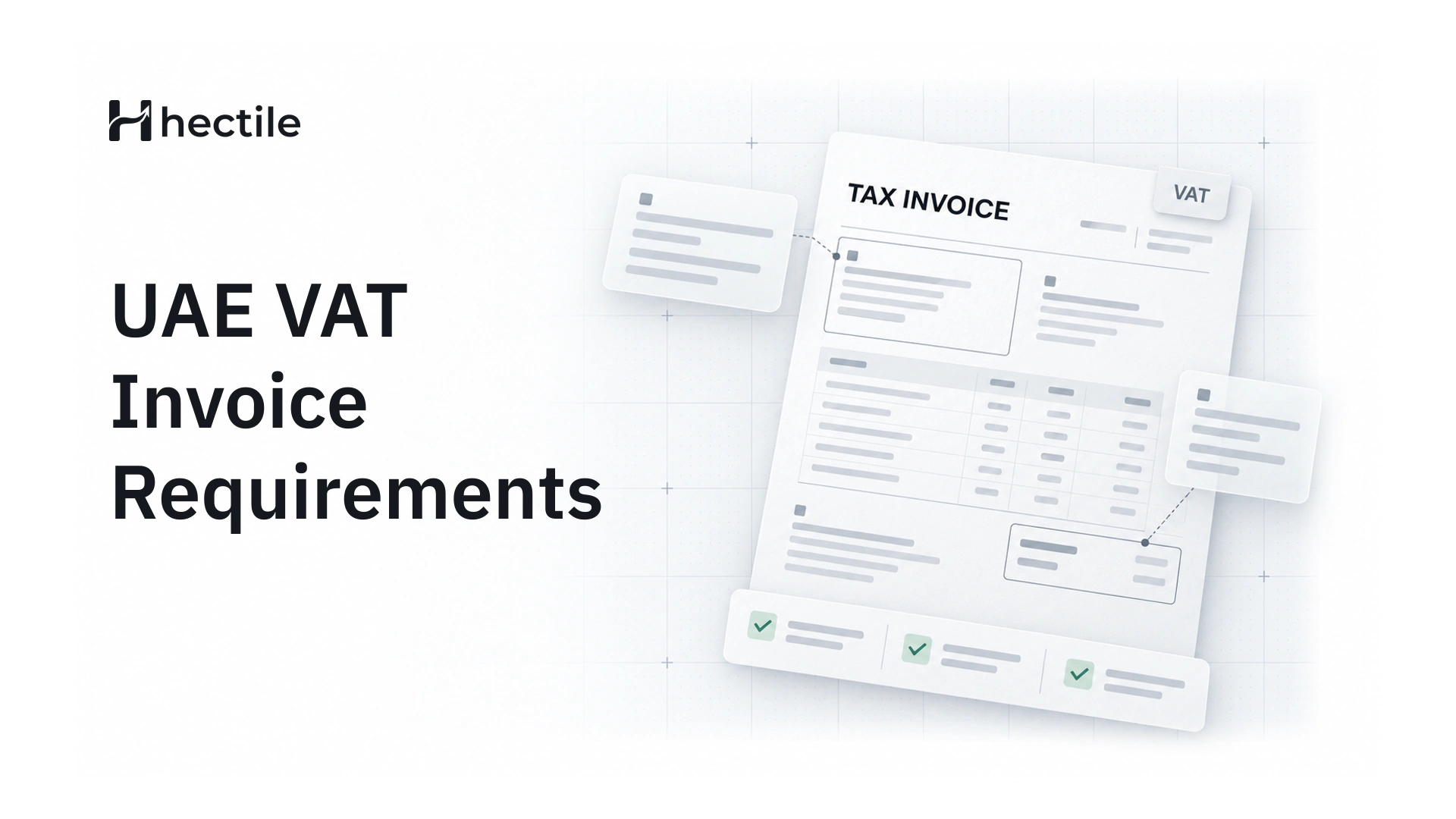
Here's the full list in plain language:
- The words "Tax Invoice", clearly displayed.
- Your name, address and Tax Registration Number (TRN).
- Your customer's name and address, and their TRN if they're registered.
- A sequential invoice number, or a unique number that identifies the invoice.
- The date of issue.
- The date of supply, if it differs from the date of issue.
- A description of the goods or services.
- For each item: the unit price, quantity or volume, VAT rate and amount payable in AED.
- Any discount offered.
- The gross amount payable in AED.
- The VAT amount payable in AED, together with the exchange rate used if you've converted from another currency.
- A statement that reverse charge applies, where the customer is responsible for accounting for the VAT.
The AED requirements are the ones most often missed. You can invoice in another currency, but the VAT amount must be stated in dirhams.
When a simplified tax invoice is enough
A simplified tax invoice can be issued when:
- the customer is not registered for VAT, or
- the customer is registered, but the amount of the supply does not exceed AED 10,000.
A simplified invoice needs fewer details:
- the words "Tax Invoice"
- your name, address and TRN
- the date of issue
- a description of the goods or services
- the total amount charged and the VAT amount
Many small businesses still issue full tax invoices every time. It's one format to maintain, and it never falls short.
Full or simplified: which should you use?
Here's how the choice plays out for three typical businesses:
- A café selling to walk-in customers. Most customers aren't VAT-registered, so a simplified tax invoice, usually the receipt, covers it.
- A consultancy billing companies. Most clients are registered and most invoices exceed AED 10,000, so full tax invoices are needed. Using the full format for everything is simplest.
- A supplier with a mix of small and large orders. Small orders to registered customers can use simplified invoices, but switching formats by order size invites mistakes. Most choose the full format throughout.
Zero-rated and exempt supplies
Two categories cause confusion. Zero-rated supplies, such as certain exports, are still taxable, just at 0%. They still need a tax invoice, showing a VAT rate of 0%. Exempt supplies, such as certain financial services and residential property, carry no VAT at all and aren't tax invoices. If your business makes both taxable and exempt supplies, keep them clearly separated on your documents and check the treatment with your adviser.
The 14-day rule
A tax invoice must generally be issued within 14 days of the date of supply. Supply dates can be less obvious than they seem: for services, the date can be triggered by completion, by receiving payment or by issuing an invoice, whichever comes first. The safest habit is to invoice as soon as work is delivered or a payment milestone is reached.
Worked example
Take a Dubai agency billing a registered client AED 12,000 for a month of social media management at the standard 5% rate:
| Line | Amount |
|---|---|
| Social media management, October | AED 12,000.00 |
| VAT at 5% | AED 600.00 |
| Total payable | AED 12,600.00 |
Because the supply exceeds AED 10,000 and the customer is registered, this needs a full tax invoice, with both TRNs, the invoice number, the date and the VAT shown in AED.
Billing in US dollars
If the same agency bills a client USD 3,000 instead, it can do so, but the invoice must also show the VAT amount in AED and the exchange rate used. Use the rate published by the UAE Central Bank for the date of supply, and keep a note of it.
Corrections: tax credit notes
If you need to reduce the amount of an invoice after it's been issued, for a discount, a return or an error, the usual route is a tax credit note rather than editing the original. Never alter a tax invoice that's already been issued. A clean trail is what the FTA expects to see.
E-invoicing is coming: what changes and when
The UAE is moving to mandatory electronic invoicing in phases. Under the timeline announced by the Ministry of Finance:
- Businesses with annual revenue of AED 50 million or more must appoint an Accredited Service Provider (ASP) by 30 October 2026 and start e-invoicing from 1 January 2027.
- Other businesses in scope must appoint an ASP by 31 March 2027 and start from 1 July 2027.
- Government entities follow from 1 October 2027.
Under e-invoicing, invoices are exchanged in a structured digital format through an accredited provider, not just emailed as PDFs. Businesses can also adopt it voluntarily before their phase begins.
For most small businesses the practical step today is the same: make sure your invoices already carry complete, accurate data, because the data is what e-invoicing transmits. Hectile isn't an Accredited Service Provider, so when your phase starts, you'll exchange e-invoices through an ASP of your choice.
Common UAE VAT invoice mistakes
- Billing in a foreign currency without stating the VAT in AED.
- Missing the customer's TRN on a full tax invoice.
- Leaving out the words "Tax Invoice".
- Issuing the invoice weeks after the supply date.
- Editing an issued invoice instead of issuing a credit note.
- Charging VAT before you're registered.
How Hectile helps with UAE VAT invoices
Hectile doesn't decide how VAT applies to your supplies. What it does is make sure your documents carry the right details, consistently:
- Your TRN from your Organization's details, and your customer's TRN from their saved record.
- A VAT tax profile you set up once, such as "VAT 5%", applied as tax-exclusive or tax-inclusive.
- Clear line amounts, with the VAT rate and amount shown and a total in the document's currency.
- A tax reporting currency: if you invoice in USD, Hectile calculates the tax in AED using the exchange rate you enter and prints that rate on the invoice.
- Sequential numbering per brand, assigned when you finalize, so numbers are never skipped or reused.
- Issued invoices that don't change, with a full history of what was sent and when.
You can see a sample on the UAE VAT invoice generator page. The Help guide to taxes and tax profiles explains tax-exclusive and tax-inclusive pricing, and the Help guide to currencies covers how each document's currency is chosen. For numbering, see our guide to invoice numbering formats and rules.
Frequently asked questions
What must a UAE tax invoice include?
A full tax invoice must show the words "Tax Invoice", your name, address and TRN, the customer's name, address and TRN if registered, a sequential invoice number, the date of issue and of supply, a description, unit prices, quantities, the VAT rate and amount for each item in AED, any discount, the gross amount in AED, and a reverse charge statement where it applies.
When can I issue a simplified tax invoice in the UAE?
When the customer isn't registered for VAT, or when the customer is registered but the supply doesn't exceed AED 10,000. A simplified invoice still needs the words "Tax Invoice", your name, address and TRN, the date, a description, and the total with the VAT amount.
Can I issue a UAE tax invoice in US dollars?
Yes, you can invoice in another currency, but the VAT amount must also be shown in AED, along with the exchange rate you used. The UAE Central Bank rate for the date of supply is the one to use.
How long do I have to issue a tax invoice in the UAE?
Generally within 14 days of the date of supply. Because the supply date can be triggered by payment or invoicing as well as delivery, it's safest to invoice promptly when work is completed or a payment is due.
Does UAE e-invoicing apply to small businesses?
Eventually, for businesses in scope. Businesses with revenue of AED 50 million or more start from 1 January 2027, and other businesses in scope from 1 July 2027, each through an Accredited Service Provider. Until your phase begins, a correctly formatted tax invoice remains the requirement.